
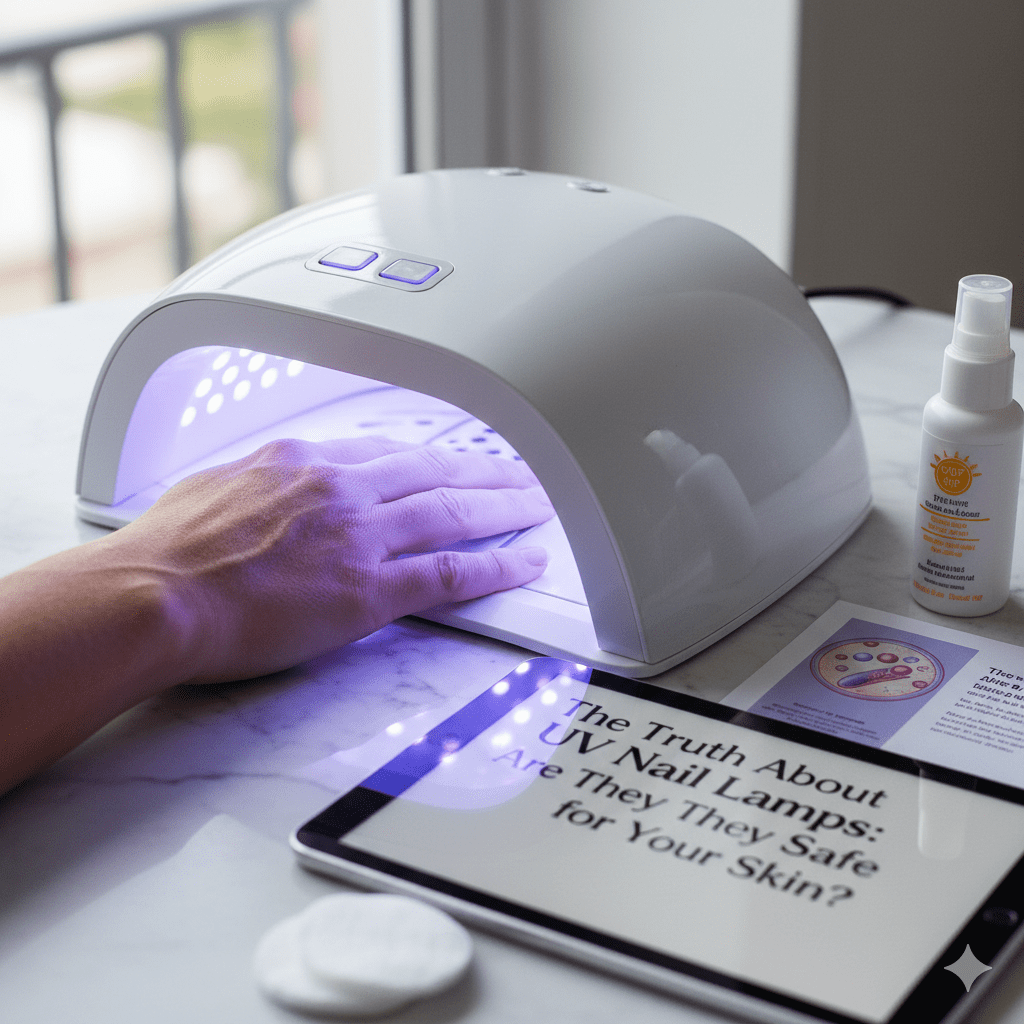

If you’ve ever slipped your hand under a UV nail lamp and felt that slight warmth, you’ve probably wondered, “Is this actually safe for my skin?”
After 10 years as a professional nail technician and beauty editor, I’ve seen many clients hesitate mid-manicure with this exact concern—and honestly, it’s a valid one.
Gel nails are gorgeous, long-lasting, and glossy, but UV exposure is a real topic we need to talk about honestly, without fear-mongering or marketing fluff. Let’s break down what’s true, what’s exaggerated, and what you can actually do to protect your skin while enjoying gel manicures.
What Is a UV Nail Lamp, Really?
UV nail lamps are devices designed to cure (harden) gel polish by emitting ultraviolet light.
How UV Nail Lamps Work
- Gel polish contains photoinitiators
- UV or LED light triggers a chemical reaction
- The polish hardens and bonds to the nail
This process is efficient—but it does involve UVA radiation, the same type linked to skin aging.
UV vs LED Nail Lamps: Is One Safer?
UV Nail Lamps
- Emit a broader spectrum of UV light
- Take longer to cure (2–3 minutes per layer)
- Older salon models often fall into this category
LED Nail Lamps
- Emit a narrower, targeted wavelength
- Cure polish faster (30–60 seconds)
- Still UV-based, but lower exposure overall
Professional insight: LED lamps are not UV-free. They are simply more efficient, meaning your skin is exposed for a shorter time.
The Real Risk: What Science Actually Says
Let’s get practical—not dramatic.
What Studies Suggest
- UV nail lamps emit low-level UVA radiation
- Exposure is intermittent, not daily
- Cancer risk is considered very low, especially with precautions
As a technician, I’ve worked with clients who get gel nails every 2–3 weeks for years with no visible UV damage, but I have seen premature aging on hands from unprotected exposure.
The bigger concern isn’t cancer—it’s cumulative skin aging.
Signs Your Hands Are Aging Faster Than Your Face
Your hands are often the first place UV damage shows up.
Watch for:
- Fine lines on the knuckles
- Sun spots or uneven pigmentation
- Thinning, crepey skin
- Loss of elasticity
If your face looks youthful but your hands don’t, UV nail lamps may be contributing.
Pro Tip: How Pros Protect Their Skin During Gel Manicures
This is what I personally do—and what I recommend to every client.
Pro Tip: Use SPF + UV Gloves Together
- Apply broad-spectrum SPF 30+ to hands
- Wait 15–20 minutes before curing
- Wear fingerless UV-protective gloves during curing
This combo reduces UV exposure by over 90%—far more effective than SPF alone.
Common Mistakes to Avoid (I See These Daily)
Avoiding these can make a huge difference long-term:
- Applying sunscreen right before curing (it won’t absorb)
- Using facial SPF instead of hand-appropriate formulas
- Over-curing “just to be safe”
- Using outdated or low-quality lamps
- Doing gel manicures back-to-back with no breaks
Expert note: Over-curing doesn’t make gel last longer—it just increases UV exposure.
Step-by-Step: How to Safely Use a UV Nail Lamp at Home
If you do gel nails yourself, follow this exact process.
Step 1: Prep Your Skin
- Wash and dry hands
- Apply SPF 30+ (non-greasy)
- Let it absorb fully
Step 2: Protect Strategically
- Wear UV gloves, exposing only nails
- If no gloves, apply SPF twice
Step 3: Cure Efficiently
- Use an LED lamp if possible
- Follow brand-recommended curing times
- Avoid unnecessary re-curing
Step 4: Post-Care Matters
- Apply cuticle oil
- Use a hand cream with antioxidants
- Massage to boost circulation
Are At-Home UV Lamps More Dangerous Than Salon Lamps?
Not necessarily—but quality matters.
What to Look for in a Safe Lamp
- Trusted brand with certifications
- LED technology
- Automatic timers
- Even light distribution
Cheap lamps often:
- Cure unevenly
- Require longer exposure
- Increase skin and nail damage
As a rule: If it costs less than a gel polish bottle, don’t trust it.
UV Nail Lamps and Skin Cancer: Let’s Address the Fear
This question comes up a lot, so here’s a clear answer.
- There is no strong evidence linking nail lamps alone to skin cancer
- Reported cases are extremely rare
- Risk increases with no protection + very frequent use
If you have:
- A history of skin cancer
- Photosensitive conditions
- Medications that increase UV sensitivity
👉 Speak to a dermatologist before regular gel use.
Safer Alternatives If You’re Still Concerned
If UV exposure makes you uneasy, you still have options.
Lower-Risk Nail Options
- Traditional polish with quick-dry topcoats
- Gel-like hybrid polishes (no lamp)
- Press-on nails (high-quality, reusable)
- Dip powder with LED-only curing
Each option has trade-offs, but safety is about informed choice, not fear.
My Professional Take After 10 Years in the Industry
UV nail lamps are not the villain they’re often made out to be—but ignoring protection is a mistake.
When used correctly, with:
- LED lamps
- SPF
- UV gloves
- Reasonable frequency
They are very low-risk for most people.
I still get gel nails. I just do it smart.
Final Thought: Beauty Should Never Be Blind
Your nails can be flawless and your skin can stay healthy—you don’t have to choose.
Once you understand UV nail lamps safety, it’s easy to protect yourself without giving up what you love.
Let me ask you: do you currently protect your hands during gel manicures, or is this something you’ll start doing after today?
Disclaimer: I am a professional nail technician, not a dermatologist. This article is for educational purposes only. If you have concerns about skin spots or UV sensitivity, please consult a medical professional.